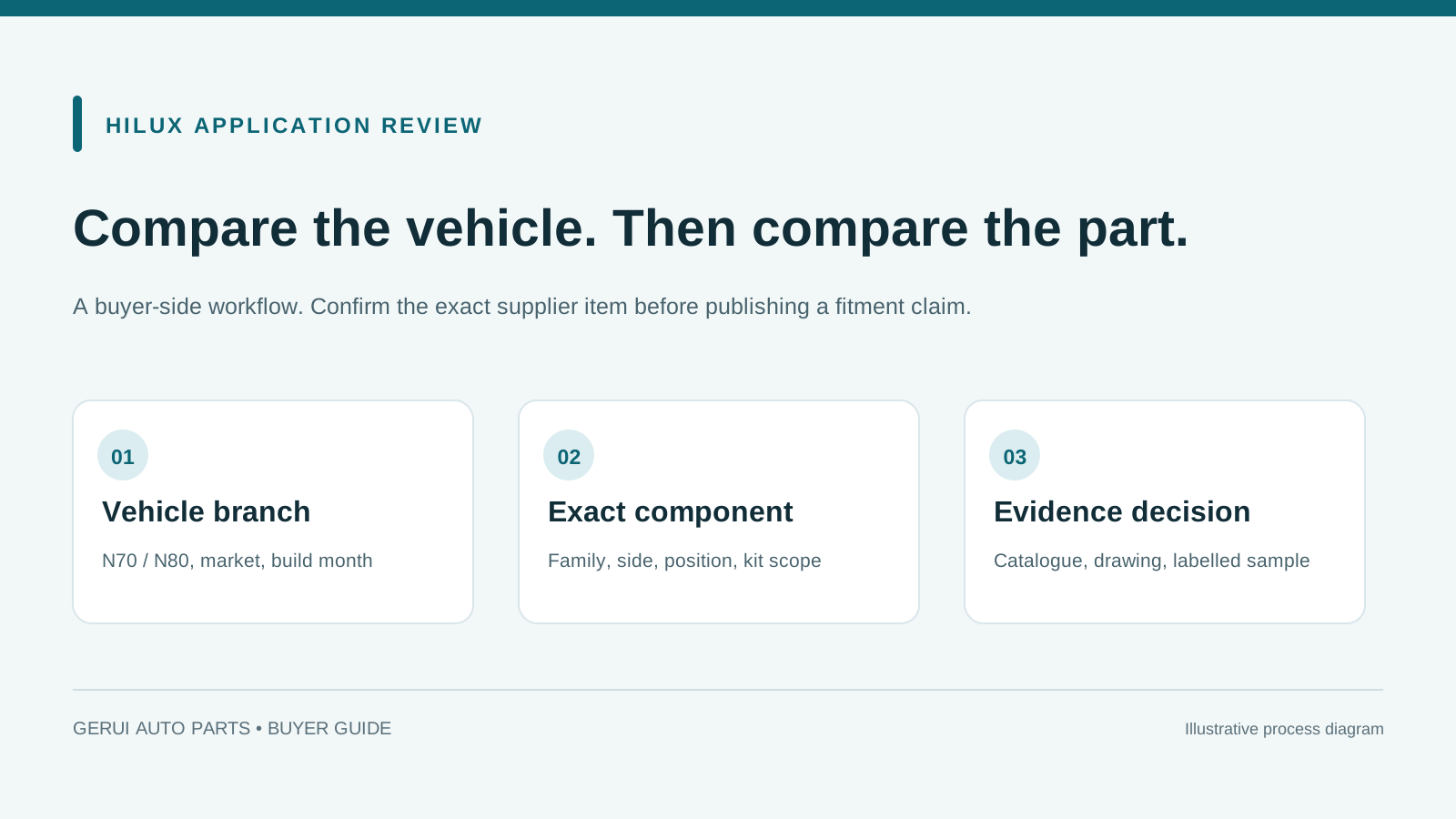
If you are building a Hilux replacement-parts range, “N70” and “N80” are useful starting points, but they do not approve a single part for sale. A buyer may send a model year, a photograph and an OE number copied from a retail listing. Those details can refer to different vehicle branches or even different positions on the vehicle. Before you compare suppliers, you need one defined vehicle application and one defined component. This checklist shows how to separate the two generations, record uncertainty and request evidence that a parts distributor can actually use.
N70 and N80 identify vehicle families, not interchangeable parts
Australian parts catalogues often use N70 and N80 as separate navigation labels. That helps a buyer begin a search, but it is not evidence that every steering or suspension component changes at the same date. Check the exact product record before drawing a cross-generation conclusion.
The opposite shortcut is equally risky. A Blackhawk adjustable upper-arm listing names both N70 and N80 for its particular product. That statement belongs to that product and its stated conditions. You cannot extend it to an entire control-arm category, a standard replacement arm, or a complete suspension kit. When you see a cross-generation claim, identify the exact SKU and the source of that claim before you reuse it.
Record the exact vehicle before opening a parts catalogue
Use one row per vehicle branch. If a field is unknown, mark it unknown; do not replace it with a guess from the sales year.
| Vehicle field | What you should request | Why it matters |
|---|---|---|
| Market and steering | Destination country and RHD/LHD configuration | Catalogue coverage may differ by market or steering arrangement. |
| Identity | Chassis/model code and build month | A broad generation label can hide production changes. |
| Configuration | Engine, 2WD/4WD, body and relevant options | The candidate part may have exclusions. |
| Existing part | Old-part label, OE reference and clear photographs | These are cross-checks, not standalone approval. |
| Work required | Part family, axle, side and installation position | “Steering kit” can describe several different assemblies. |
If you cannot obtain a VIN, use the best available build-plate and old-part information, then keep the application pending until the supplier can explain its coverage. A photo can help identify a component, but it does not establish a precise fit on its own.
Make a separate decision for each part family
An N70 versus N80 suspension comparison should not have one answer for the whole vehicle. Start with the component that your customer actually wants to stock:
- For a steering repair, separate the rack, inner rack end, outer tie-rod end, boots and hardware. Ask whether the quote covers one side or a complete vehicle set. The tie-rod measurement guide lists the information needed before sampling.
- For control arms, separate upper from lower, left from right, and complete assemblies from bare arms or service parts. A lifted-vehicle adjustable arm belongs in a different comparison from a standard replacement arm.
- For stabilizer parts, record link position and bushing dimensions rather than assuming that a shared model name proves the same bar or mounting details.
You can use the Hilux N70 vehicle programme and Hilux N80 vehicle programme as navigation points. Each proposed product still needs its own application record and supplier evidence.
Give every proposed match an evidence status
A practical comparison has four states: confirmed for a named SKU and vehicle branch, conditional on a missing configuration, conflicting sources, or unknown. Record the source, date and person who reviewed the row. “Confirmed” should mean that the catalogue reference, product identity and relevant dimensions or sample checks support the same application. If two sellers disagree, keep the row in the conflicting state and investigate; the lower quoted price does not settle the fitment question.
For an initial supplier response, request its application table, the original cross-reference source, drawing revision, side and position, included components, photographs of a labelled sample and any exclusions. Ask the supplier to distinguish a current standard replacement item from an upgrade designed for a modified vehicle. You can then compare two quotations against the same vehicle and bill of materials rather than two vaguely named “Hilux kits.”
Buyer questions before a trial order
Does one part listed for N70 and N80 prove both full kits fit? No. A listing proves only what that seller states for that exact SKU. Review each component and its stated conditions separately.
Is the registration year enough to pick a generation? No. Ask for the build date and chassis or model code, particularly near a changeover period.
Can I use a retail OE number as my private-label cross-reference? Treat it as a lead. Verify its source, side, supersession and the proposed supplier part before adding it to your catalogue.
What if the old part has no readable label? Keep the match pending. Ask for measurements, clear photographs, the vehicle record and a supplier drawing or sample.
Should I quote a complete kit before every item is verified? You can request a provisional bill of materials, but mark each unresolved item and avoid presenting the complete kit as approved stock.
Turn the comparison into a useful RFQ
You do not need a perfect catalogue to start a sourcing conversation. Send the exact vehicle branch, the repair scope, any OE or old-part reference, the proposed quantity and the information still missing. Ask for a line-by-line reply that identifies the product, side, bill of materials and evidence source. Request an application review and quotation when you have those basics. Gerui can review sourcing feasibility; exact fitment, availability and commercial terms must be confirmed for each quoted item.