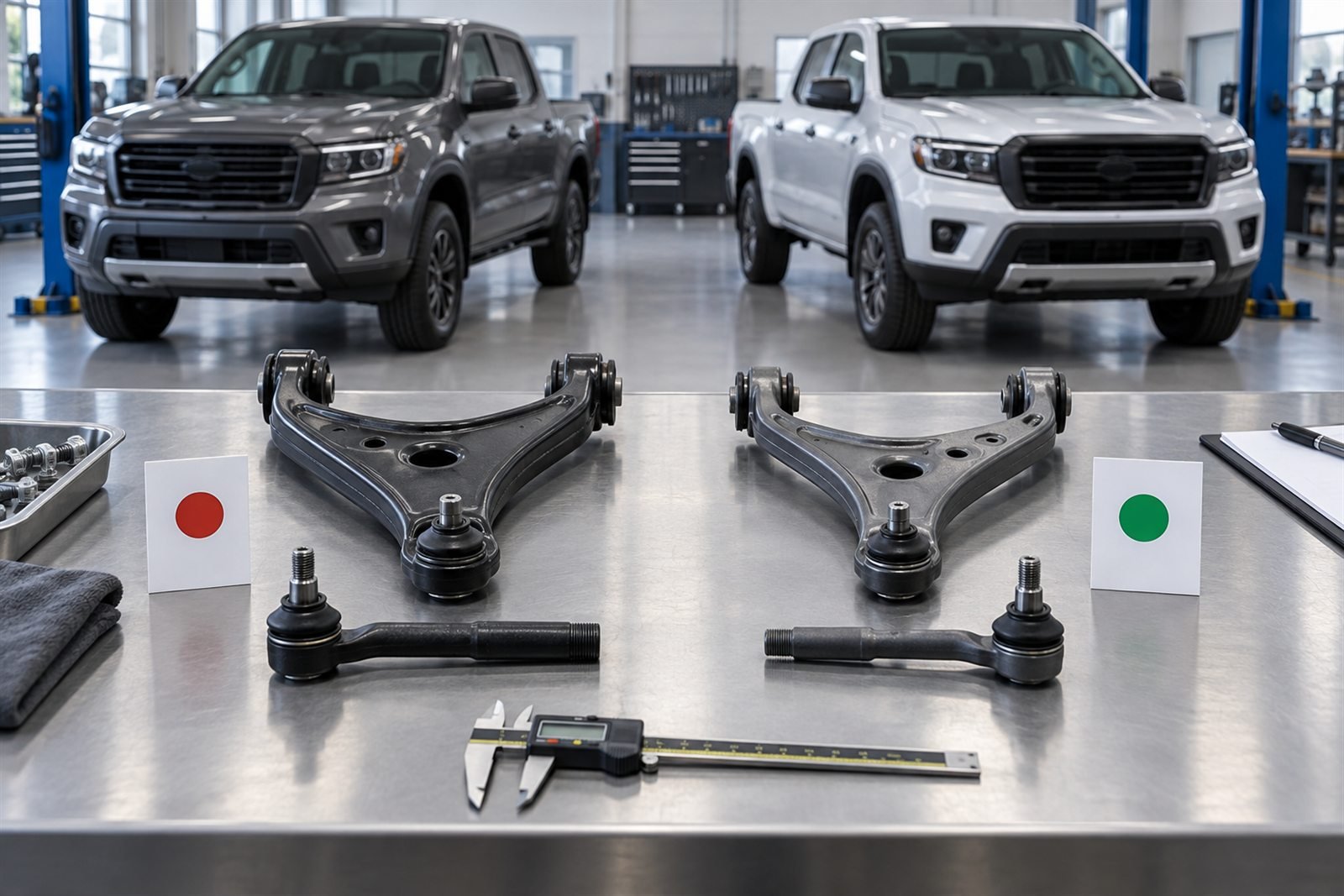
Vehicles that share architecture, factories or supplier catalogs may still use different steering and suspension parts. This guide gives B2B buyers a repeatable way to test an interchange claim before quotation or sampling.
Use evidence in layers
Start with the vehicle record, then confirm the exact installation position, OE or supplier identity, critical dimensions and actual sample. Do not promote a cross-reference from appearance alone.
Minimum vehicle record
- Destination market and RHD or LHD configuration.
- Model series, build month, chassis or VIN reference where appropriate.
- Body, drivetrain, steering and suspension configuration.
- Standard or modified ride height and relevant option codes.
Minimum part record
| Layer | Record | Decision |
|---|---|---|
| Identity | OE reference, supplier code, position and quantity per vehicle. | Defines what is being compared. |
| Geometry | Thread, taper, length, mounting centres, bushing or joint dimensions as relevant. | Tests whether the proposed match is physically credible. |
| Evidence | Drawing, labelled sample, traceable catalog source and available inspection records. | Shows the basis and limitations of the claim. |
| Commercial | MOQ, packing, lead time, warranty and claim process. | Defines the trial-order risk. |
Review workflow
- Record the buyer’s current number and vehicle data.
- Separate generation, side, axle and position.
- Request the supplier drawing and stated cross-reference source.
- Compare critical dimensions before ordering a sample.
- Inspect and label the sample against the agreed application.
- Record unresolved points before approving a trial order.
Common failure points
- Model-year ranges copied without build-month splits.
- Shared-platform vehicles treated as identical without part-level evidence.
- RHD and LHD rack or joint differences omitted.
- Left, right, inner, outer, front or rear positions missing.
- Kit photographs used without an itemized BOM.