Australian parts importers need more than a low unit price. A usable quote should connect the replacement part to the right vehicle application, show exactly what is included, identify open evidence questions, and state the delivery term and excluded costs. This page outlines how to structure that review when evaluating selected steering and suspension ranges for the Australian aftermarket.
Start with a defined buying scope
Gerui’s initial validation focus is standard-replacement steering and suspension parts for selected Japanese RHD pickups and SUVs sold in Australia. A model name alone does not establish fitment, availability, supplier capability, or a commercial offer. Each application and SKU needs its own review.
1. Separate the vehicle application before requesting price
Record the make, model and generation, build period, chassis or platform reference, engine or drivetrain where relevant, and right-hand-drive configuration. Then state axle, left or right side, inner or outer position, OE or current reference number, and any dimensions or drawing revision available. If two catalogs disagree, keep the conflict visible instead of choosing the match that looks closest in a photo.
For pickups and SUVs, the same model family can span different build phases and configurations. RHD market coverage is a separate check. Ask the source of each reference, whether the data describes the exact quoted part, and what evidence is available to resolve a mismatch. See the fitment and quality framework for the records to request.
2. Compare a complete repair scope, not isolated component prices
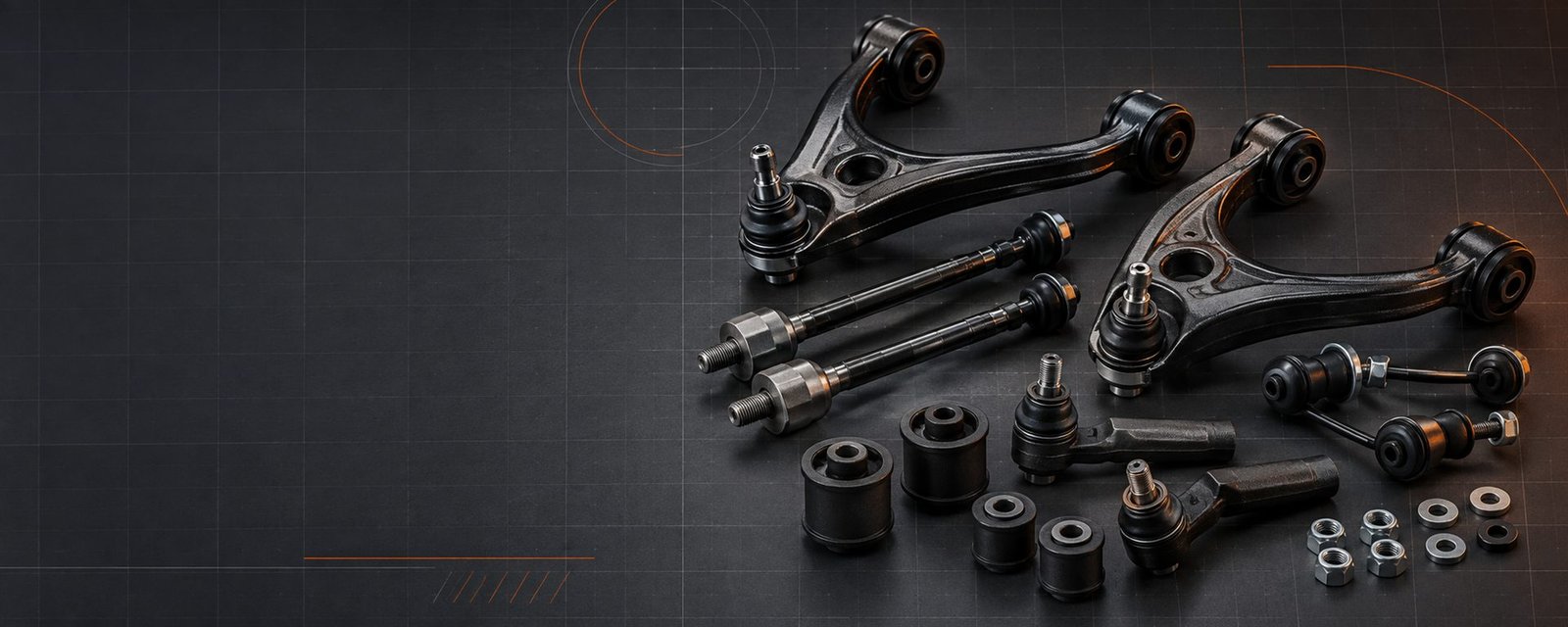
For a kit or matched set, define the bill of materials before comparing suppliers. List each component, quantity, side, fastener or accessory, protective packaging, label and barcode requirement. Ask suppliers to mark unavailable or optional items explicitly. “Kit price” is not comparable when each offer contains a different number of pieces or a different packaging basis.
Importers organizing a range around repair scenarios can review the steering and suspension service-kit programs and the related vehicle and part application library. Those pages are sourcing frameworks; the exact SKU and application are confirmed only during a product-level quotation.
3. Ask for evidence that follows the quoted item
Request the current drawing or dimensional record, material information, available inspection or test documents, sample status, batch identification method and revision date. Record whether each answer is a supplier statement, a drawing, a sample measurement, or a report tied to the product code. A sample can help check that sample; it does not by itself prove later production consistency.
Before approval, agree the inspection scope, packaging artwork and protection, traceability fields, warranty period and exclusions, claim evidence, response process and remedy. Requirements depend on the SKU and source. Do not assume one supplier document or warranty applies across a whole vehicle range.
4. Normalize the commercial offer and delivery point
Send every supplier the same quantities by SKU, packaging basis, destination postcode and requested delivery term. State the exact named place and Incoterms® edition. Ask each supplier to show included and excluded origin handling, export clearance, freight, insurance, destination terminal charges, customs brokerage, duties and taxes, unloading, and final delivery. Mark forwarder estimates separately from confirmed charges.
FOB and CIF are intended for sea or inland-waterway transport. Under CIF, the seller pays carriage and required minimum insurance to the named destination port, while risk transfers when goods are on board at the shipment port. DAP places delivery at a named destination ready for unloading; the buyer generally handles import clearance, duties and unloading. Read the EXW, FOB, CIF and DAP quotation checklist before comparing offers built on different terms.
5. Plan a controlled first order
A trial can test product data, packaging, documentation and shipment handling before a range is expanded. First confirm whether the selected source permits mixed SKUs, the minimum quantity for each item, sample costs, production lead time, packaging minimums, cargo-ready date and consolidation conditions. None of those commercial terms should be assumed from a general website statement.
Agree which sample or approved reference the order will follow, how any substitution is approved, and what records will accompany the batch. Put the accepted BOM, application, inspection checkpoints, labels, delivery term, payment milestones and claim process into the purchase documentation.
Australian importer RFQ checklist
- Company, buyer contact and Australian delivery postcode
- Vehicle make, model, generation, build period, RHD configuration and drivetrain where relevant
- OE or current reference and the source used to identify it
- Part position, side, dimensions or drawing, and requested BOM by SKU
- Quantity by item, sample request and expected repeat demand if known
- Packaging, private-label, barcode and carton-marking requirements
- Requested Incoterm, named place, shipment mode and timing
- Required inspection, traceability, product evidence, warranty and claim conditions
Questions buyers should resolve before approving a quotation
- Does the evidence identify the exact part number, vehicle configuration and revision being quoted?
- Do all offers contain the same components, quantities and packaging?
- Which price and delivery costs are confirmed, estimated or excluded?
- What MOQ and lead time apply to each SKU and private-label component?
- How will the sample, production batch and shipment records be linked?
- What written inspection, warranty and claim conditions apply to the selected item?
Use one comparison sheet for every supplier
Put quotations into the same columns before choosing a source. For each field, mark it confirmed, open, conflicting or not applicable, and record who supplied the evidence and when. An open field is a follow-up task; it should not disappear when a low unit price looks attractive.
| Comparison area | Record for each offer | What the buyer should verify |
|---|---|---|
| Application | Vehicle generation, build range, RHD, drivetrain, position, OE reference | Does the supplier answer identify the same application and reference source? |
| Kit scope | Part number, components, quantity per kit, LH/RH, hardware | Are the two BOMs identical, with options separated from included items? |
| Product evidence | Drawing revision, dimensions, material statement, inspection or test record | Can the evidence be tied to the quoted SKU, sample or production batch? |
| Packaging | Unit pack, master carton, labels, barcode, artwork, protection | Are packaging quantities, cost, approval steps and lead time stated? |
| Commercial terms | Price basis, currency, MOQ by SKU, validity, payment schedule | Are optional charges and quantity breaks visible? |
| Delivery | Named Incoterm and place, shipment mode, cost inclusions, timing | Are the delivery point, transit assumptions and excluded destination charges clear? |
| Risk after delivery | Warranty, claim evidence, response route, remedy, traceability | Can both parties identify affected items and agree how a claim is reviewed? |
Examples of application details that should stay separate
These examples are prompts for the RFQ, not confirmation that a part fits every version of a model:
- Toyota Hilux N80: provide build date, chassis reference, RHD, drivetrain, OE number, position and quantity.
- Ford Ranger PX: state PX1, PX2 or PX3 where known, plus build period, drivetrain, side and OE reference.
- Toyota Prado J150: state KDSS or non-KDSS where applicable and provide chassis/build details and the requested component position.
A shared platform, body shape or catalog listing does not prove that two vehicles use interchangeable steering or suspension parts. Keep each application record tied to a source and revision. If two sources disagree, hold the application open until the conflict is resolved.
Calculate an apples-to-apples order cost
First normalize the goods: same SKU, quantity, BOM and packaging. Then build a landed-cost worksheet with one row for each confirmed amount: goods, origin pickup or handling, export documentation, international freight, insurance, destination terminal charges, customs brokerage, duties and taxes, unloading, local transport and any agreed inspection. Mark unknown amounts as pending, not zero. Ask a freight forwarder to confirm route-dependent charges before treating the result as a landed cost.
Compare both totals and uncertainty. A quote with a lower item price may have a higher destination bill, a different kit scope or an unpriced packaging requirement. Keep supplier charges, forwarder estimates and buyer-side charges in separate columns so the next person can trace the calculation.
Sample and first-order approval record
Before a sample is paid for, write down the exact sample part number, intended production source if confirmed, application data, dimensions to check, packaging, sample quantity, cost, freight and the decision owner. Record the measurement method and results after receipt. Approval of one sample applies to what was inspected; it is not proof of every future batch unless the agreed production controls support that conclusion.
Before releasing a trial purchase order, attach the approved application record and BOM, agreed packaging artwork, inspection scope, batch-marking requirement, named delivery term, order quantities and claim procedure. Note any substitutions that require written approval. Use the sample inspection checklist and supplier claim-terms checklist to prepare those questions.
Questions Australian buyers can send with a buying list
- Please identify the exact application and tell us which OE or source data supports it.
- List every component and quantity included in the quoted set; identify options separately.
- State which drawings, measurements, material records or product-level reports match this SKU and revision.
- Quote MOQ, sample cost, production lead time, packaging minimums and quotation validity by item.
- State the named Incoterm and place, included freight/insurance services and excluded destination charges.
- Explain how samples and future batches will be identified, inspected and linked to records.
- Provide the written warranty and claim process, including required evidence and available remedies.
Frequently asked questions
Can a model and year alone confirm steering-part fitment?
Usually that is not enough for a buyer approval. Supply build, chassis, steering configuration, drivetrain, OE reference and position details where available; the exact data needed depends on the application.
Does a product photo confirm that the part fits?
No. Images can help identify a candidate but do not prove dimensions, configuration, materials, application or kit contents.
Can different SKUs be combined in a first order?
Ask for MOQ, production status, packaging and consolidation conditions for each SKU. Mixed-order terms must be confirmed by the selected suppliers.
Does DAP include Australian duties and unloading?
DAP generally leaves import clearance and unloading to the buyer. Confirm the named delivery point, taxes, brokerage and charges with the contract parties and freight professional.
What should be agreed before production?
Confirm application, BOM, approved reference or sample, inspection, packaging, traceability, order quantities, named delivery term, payment milestones and claim conditions in writing.
For the exact fields to submit, use the steering and suspension RFQ template, then send the vehicle data and buying list.
Send an Australian aftermarket buying list
Include vehicle data, OE references, a requested BOM, quantities by item, packaging requirements and destination postcode. We will identify open application and commercial questions for the selected request.